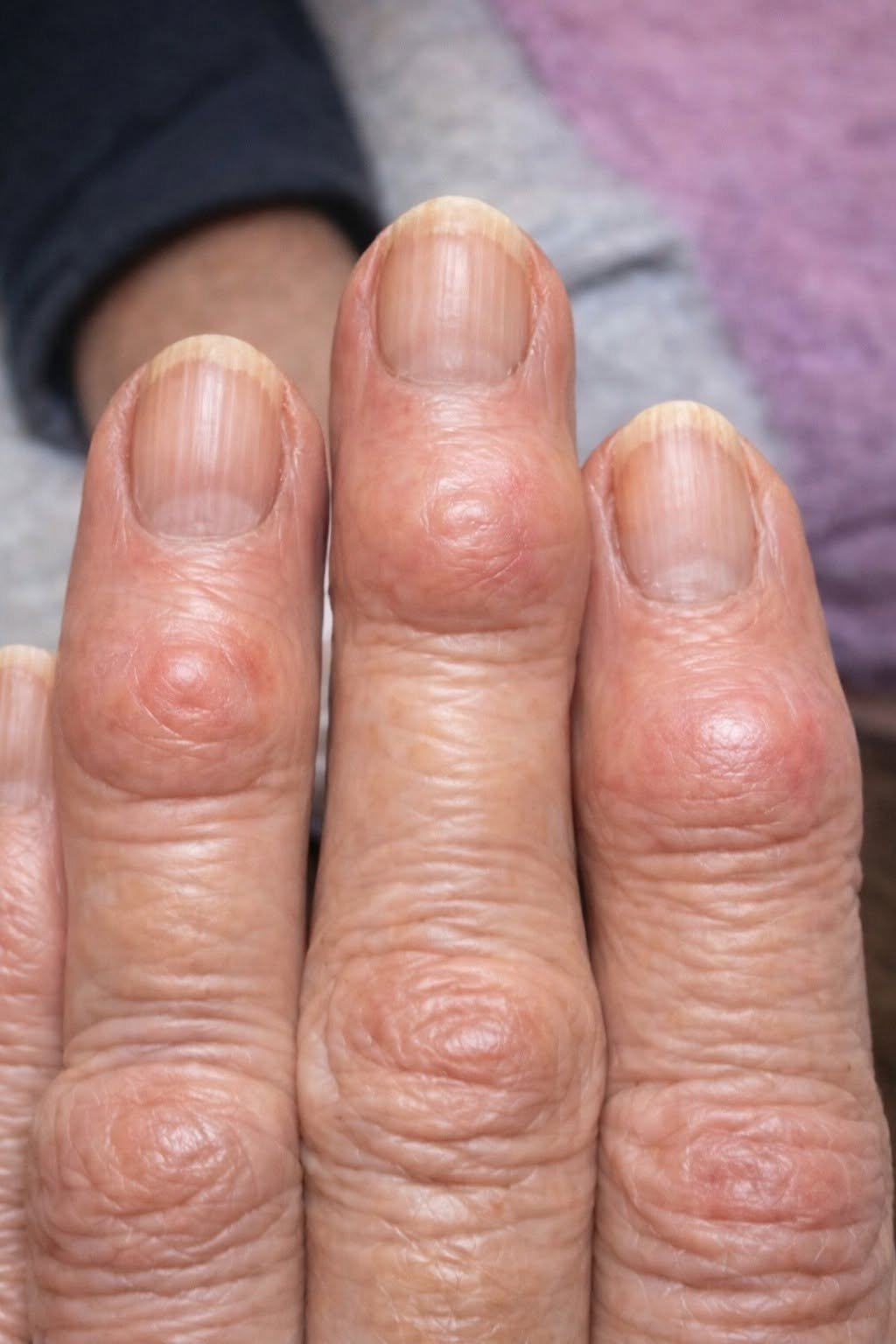
Discovering new, hard growths on your hands can be a highly concerning experience. Over time, you might notice small, knot-like bumps forming on the very last joints of your fingers, right below the nail bed. These physical changes do more than just alter the aesthetic appearance of your hands; they can make everyday tasks—such as buttoning a coat, typing, or twisting open a jar—feel stiff, clumsy, and uncomfortable.
These hard bony developments are clinically referred to as Heberden’s nodes. Far from being a rare medical anomaly, they are one of the most common physical indicators of hand osteoarthritis—a degenerative joint condition that affects millions of adults worldwide as they age. While these bony changes are permanent, understanding the biological mechanisms behind them can help you protect your joints, relieve morning stiffness, and maintain excellent long-term hand mobility.
The Biological Science: Cartilage Breakdown and Osteophyte Formation
The Anatomy of Joint Wear
Inside every healthy finger joint, the ends of the bones are capped by a smooth, rubbery connective tissue known as articular cartilage. This cartilage serves as a vital shock absorber and low-friction glide path, allowing your fingers to bend and flex effortlessly without the bones grinding together.
As hand osteoarthritis progresses, this protective cellular cushion begins to wear thin and degrade:
-
The Structural Friction: With the cartilage buffer depleted, the bones within the distal interphalangeal (DIP) joint—the joint nearest the fingernail—begin to rub directly against each other during movement.
-
The Bone-Spur Defense: To stabilize this newly compromised, high-friction environment, your body attempts to heal itself by growing new bone tissue. These localized, hard bony outgrowths are known as osteophytes (or bone spurs). Externally, these osteophytes present as the firm, knobby bumps we call Heberden’s nodes.
For Complete Cooking STEPS Please Head On Over To Next Page Or Open button (>)